Two-Tone Leafy Branch Banner: Free Crochet Pattern
Introduction
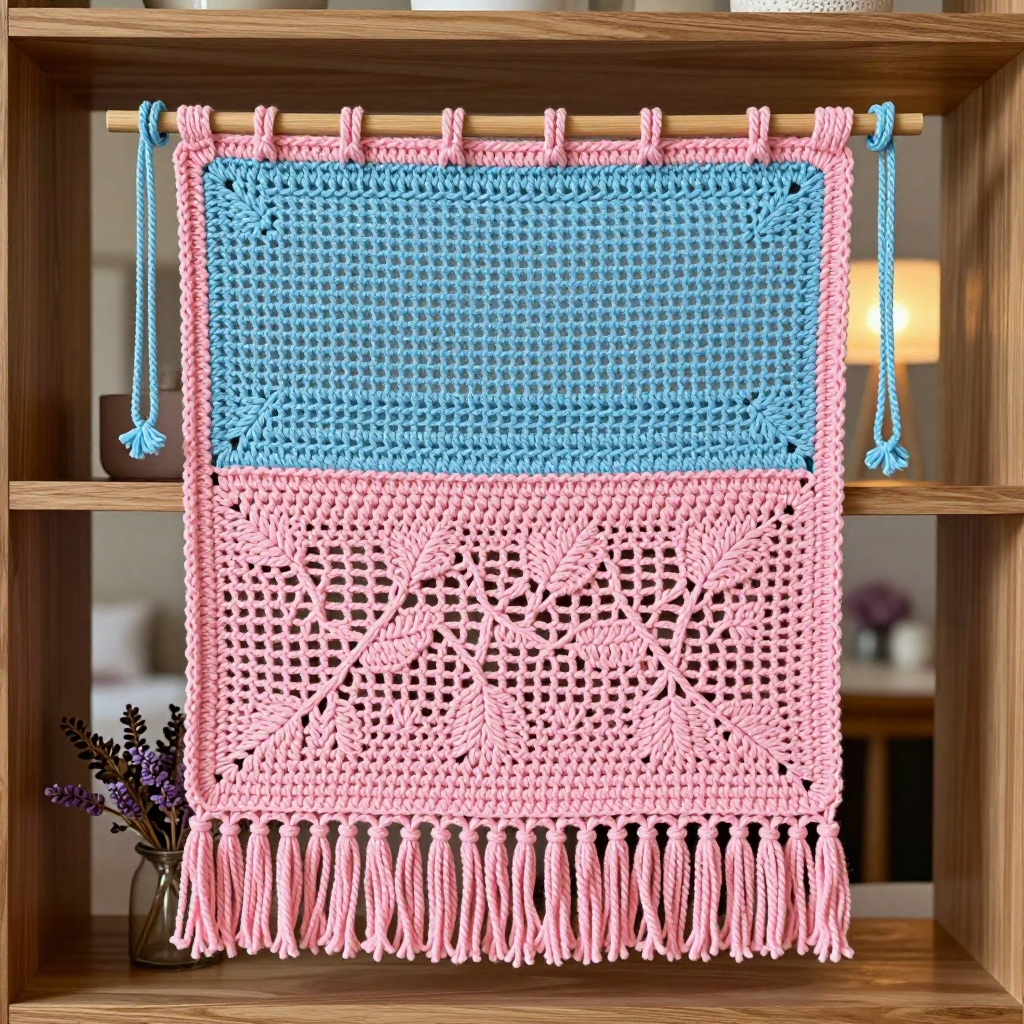
This Two-Tone Leafy Branch Banner is a gentle, beginner-friendly filet crochet project that brings a little cottagecore charm to any wall. It's designed for crocheters who have mastered double crochet and are ready to try their first filet chart, with a simple two-color gradient doing most of the visual work. The lower half blooms in cotton candy pink with open leafy vine motifs, while the upper half shifts to baby blue in a solid mesh, creating a soft sunset-like fade. Worked in worsted-weight cotton, the finished panel is crisp, lightweight, and drapes beautifully from its wooden dowel with a fringe of pink tassels below.
Materials Needed
- Yarn: Worsted weight (category 4) recycled cotton, 100% cotton, 2 oz (56 g) / 85 yds (78 m) per skein
- Color A (cotton candy pink): 1 skein (approx 60 yds used)
- Color B (baby blue): 1 skein (approx 40 yds used)
- Hook: 5.0 mm (US H-8) crochet hook
- Notions: Tapestry needle, scissors, tape measure, 14-inch (35.5 cm) wooden dowel
- Finished size: Approx 12 inches (30.5 cm) wide x 18 inches (45.7 cm) long, excluding fringe and dowel
Abbreviations
- ch — chain
- dc — double crochet
- sc — single crochet
- sl st — slip stitch
- RS — right side (the front of the panel)
- st(s) — stitch(es)
- sk — skip
Gauge
4 dc and 2 rows = 1 inch (2.5 cm) in filet pattern. To check, crochet a small swatch in the filet pattern and measure a 1-inch section; adjust your hook size if needed to match.
Tips Before You Start
- Count your blocks at the end of every row — each row should total 12 blocks (48 dc) so the panel stays square and the chart lines up.
- Keep your ch-2 mesh spaces loose and even; tight chains pull the panel in and distort the leaf motifs.
- Mark the right side with a stitch marker so you always know which way the chart faces.
- Work the color change at the end of Row 12 by finishing the last dc with Color B, so the transition is clean.
Step-by-Step Instructions
Panel
Row 1 (RS): With Color A, ch 50, dc in 4th ch from hook, dc in each ch across (48 dc).
Row 2: Ch 3 (counts as first dc), turn, dc in next 2 dc, [ch 2, sk 2 dc, dc in next 2 dc] across (12 blocks).
Rows 3–12: Ch 3, turn, work in filet pattern following the leaf vine chart (12 blocks each row).
Color change: At the end of Row 12, change to Color B.
Rows 13–24: Ch 3, turn, work in filet pattern following the solid mesh chart (all blocks filled, 48 dc each row).
Fasten off.
Edging
Rnd 1: With RS facing, join Color A with sl st in top right corner, ch 1, sc evenly around entire panel, working 3 sc in each corner. Fasten off.
Dowel
Cut the wooden dowel to 14 inches (35.5 cm). Insert it through the top edge of the panel, centering it so it extends about 1 inch beyond each side.
Fringe
Cut 24 strands of Color A, each 12 inches (30.5 cm) long. Fold 2 strands in half and attach to the bottom edge of the panel using a lark's head knot, spacing evenly for 12 knots.
Hanging
Tie a 12-inch length of Color B to each end of the dowel to form hanging loops.
Assembly and Finishing
Weave in all ends securely on the wrong side with your tapestry needle, taking care not to pull the mesh spaces tight. Gently block the panel by misting it lightly and pinning it to a towel to the finished measurements (12 x 18 inches), letting it dry flat so the filet blocks open up evenly. Once dry, insert the dowel, attach the fringe, and tie the hanging loops. Trim fringe ends evenly.
Pro Tips and Variations
- Swap the colors for a seasonal look — deep green and rust for autumn, or white and sage for a soft neutral.
- Add a second sc round in Color B around the edging for a crisp two-tone border.
- For a wider banner, add blocks in multiples of 2 dc (plus 2 for the turning chain) and extend the chart accordingly.