Harlequin Stripe Crochet Table Runner Free Pattern
Introduction
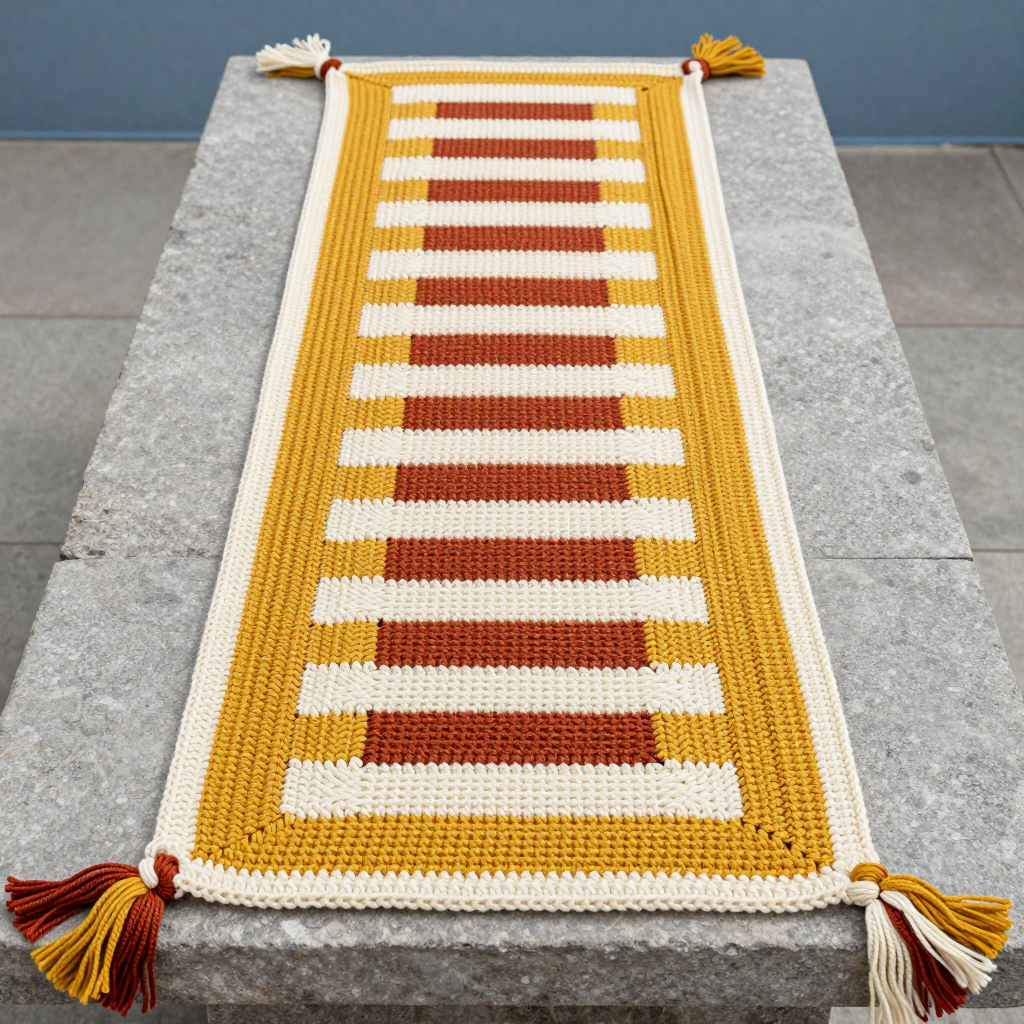
This Harlequin Stripe Table Runner is the perfect project for anyone who wants a polished, mid-century modern look on their dining table without tackling anything complicated. It's built entirely from plain single crochet, so even if you've only just learned the stitch, you can make this. The twelve lengthwise stripes in mustard, rust and cream give it that warm, retro feel, and the smooth, dense fabric drapes flat and stays put. With a simple cream border and knotted three-color fringe at each end, it looks far more involved than it actually is — and it feels wonderful under your hands as you work.
Materials Needed
- Yarn: Worsted weight (CYC 4), 100% cotton, approx. 400 yd total — Mustard (A) 150 yd, Rust (B) 130 yd, Cream (C) 120 yd
- Hook: 5.0 mm (US H-8)
- Notions: Tapestry needle, scissors, stitch markers, rust-proof pins for blocking
- Finished size: 14 in wide x 48 in long (35.5 x 122 cm), excluding 4 in of fringe at each end
Abbreviations
- ch — chain: make a loop of yarn and pull it through the loop on your hook.
- sc — single crochet: insert hook, yarn over, pull up a loop, yarn over, pull through both loops.
- sl st — slip stitch: insert hook, yarn over, pull through everything on the hook.
- RS — right side: the front, public face of the fabric.
- st(s) — stitch(es).
- R — row.
- Rnd — round.
Gauge
16 sc x 18 rows = 4 in (10 cm) in single crochet, blocked. Work a small swatch, block it, and measure a 4 in section in the middle — if you have more stitches than 16, go up a hook size; if fewer, go down.
Tips Before You Start
- Make all twelve strips first, then join. Working strip by strip keeps your tension even and lets you lay the colors out to check the sequence before seaming.
- Count your chain carefully. Each strip starts with ch 64 to give 63 stitches — a miscount here throws off the whole strip width.
- Keep your turning chain consistent. Use ch 1 at the start of each row and don't count it as a stitch, so every row stays at 63 sts.
- Match your seaming color to the stripe edge. Whipstitching with the same color as the stripe you're joining hides the seam beautifully.
Step-by-Step Instructions
Notes: The runner is worked sideways in lengthwise stripes. Each stripe is a separate strip worked in rows, then joined. Runner length = 48 in = 12 stripes of 4 in width. Runner width = 14 in = 63 rows.
Stripe 1 (Color A — Mustard)
R1: Ch 64, sc in 2nd ch from hook, sc across (63 sts).
R2–16: Ch 1, turn, sc in each st across (63 sts).
Fasten off. (16 rows = 4 in)
Stripe 2 (Color B — Rust)
R1: Ch 64, sc in 2nd ch from hook, sc across (63 sts).
R2–16: Ch 1, turn, sc in each st across (63 sts).
Fasten off.
Stripe 3 (Color C — Cream)
Work exactly as Stripe 2 (63 sts x 16 rows). Fasten off.
Stripes 4–12
Repeat the color sequence A, B, C, A, B, C, A, B, C — three full repeats — for a total of 12 stripes, each 63 sts x 16 rows. Fasten off each strip.
Assembly
With RS facing, whipstitch the long edges of adjacent stripes together in order 1–12, matching row for row, using yarn in the matching color. Weave in ends.
Edging
Rnd 1: With C, join to any corner. Sc evenly around the entire perimeter, working 1 sc per row along the long edges and 1 sc per st along the short edges, with 3 sc in each corner (approx. 350 sc). Join with sl st. Fasten off.
Fringe
Cut 126 strands of A, B and C, each 10 in long (42 per color). Holding 3 strands (one of each color) together, fold in half. Attach 21 fringe bundles evenly along each short end through the edging sts using a lark's head knot. Trim fringe evenly to 4 in.
Assembly and Finishing
Once all twelve strips are joined, weave in every remaining end on the wrong side, threading each tail through a few stitches before trimming. Block the runner to 14 x 48 in, pinning the edges straight and the fringe flat, then let it dry flat — cotton holds its shape well after a good blocking. Give the fringe a final even trim once dry.
Pro Tips and Variations
- Change the palette: Swap in teal, ochre and off-white for a cooler mid-century look, keeping the same three-color repeat.
- Make it shorter: Work 9 stripes instead of 12 for a 36 in runner that suits a smaller table — just adjust the fringe count to match.
- Skip the fringe: Leave the short ends plain for a cleaner, more modern finish, or add a second cream edging round for a bolder border.


