Crochet Charming Hexagonal Bee Baby Blanket Free Pattern
Crochet Charming Hexagonal Bee Baby Blanket Free Pattern
Introduction
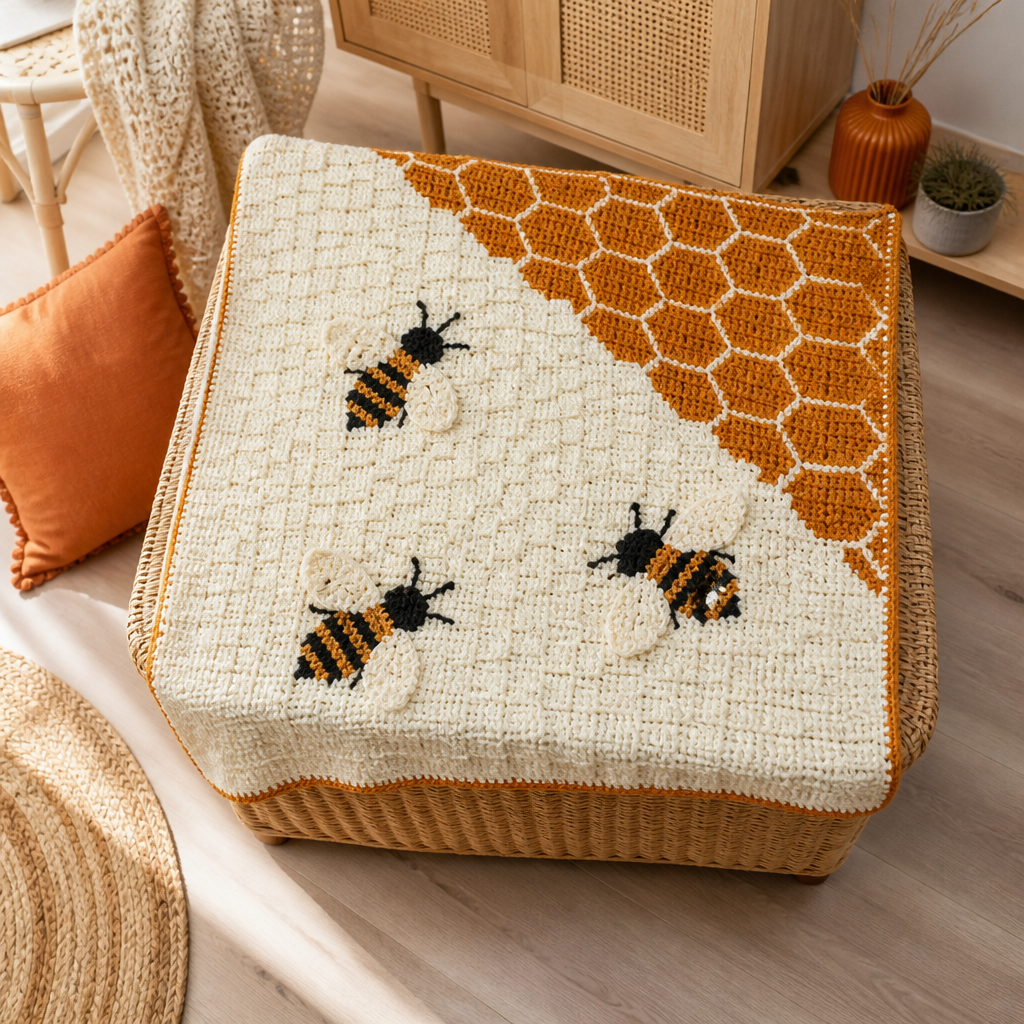
This sweet baby blanket is made for little ones and the grown-ups who love them, combining a soft corner-to-corner base with a honeycomb of orange hexagons and three friendly bees. What makes it special is the mix of textures: the smooth C2C blocks, the raised hexagon appliqués, and the tiny embroidered details that bring each bee to life. In cream, orange, mustard, black, and white, it looks like a sunny summer meadow and feels light, cozy, and perfect for spring and summer snuggles. Whether you are new to C2C or a seasoned crocheter, the step-by-step instructions below will guide you through every piece.
Materials Needed
- Yarn: DK weight yarn. Cream: approximately 1,200 yards. Orange: approximately 150 yards. Mustard: approximately 60 yards. Black: approximately 60 yards. White: approximately 30 yards.
- Hook: 4.0 mm (US G/6)
- Notions: Tapestry needle, scissors, stitch markers (optional)
- Finished size: Approximately 37" x 37"
Abbreviations
- ch – chain
- sl st – slip stitch
- sc – single crochet
- dc – double crochet
- sc2tog – single crochet two stitches together (decrease)
- sc3tog – single crochet three stitches together (decrease)
- sp – space
- st(s) – stitch(es)
- C2C – corner-to-corner (worked diagonally in blocks)
Gauge
2 squares by 2 squares = 1.5" x 1.5" (each C2C block is approximately 0.75" square). Check your gauge by crocheting a few blocks and measuring a 2-by-2 section; adjust your hook size if needed to reach 1.5".
Tips Before You Start
- Keep your C2C blocks loose and even; tight blocks make the blanket stiff and change the finished size.
- Count your blocks at the end of every increase and decrease row so the square stays symmetrical.
- Leave long tails on every hexagon and bee piece; they double as sewing thread for attaching appliqués.
- Pin the hexagons in place before sewing so the honeycomb pattern stays aligned and butted together.
Step-by-Step Instructions
Corner-to-Corner Base (Cream)
First block: Ch 6, dc in the 4th, 5th, and 6th ch from hook (1 block).
Joining a block: Ch 6, dc in the 4th, 5th, and 6th ch from hook, then sl st into the ch-3 sp of the adjacent block to join.
Increase row: Turn, ch 6, work a block into the turning ch, then work blocks across, joining each to the previous block, and end with a block in the last space (increase at both ends).
Rows 1–49: Repeat the increase row until the side measures approximately 37" (about 49 blocks along the diagonal). The base is now a square with 49 blocks on each side.
Decrease row: Turn, sl st across the first block, ch 3, work blocks across, joining as before, and stop before the last block (decrease at both ends).
Remaining rows: Repeat the decrease row until one block remains. Fasten off and weave in ends.
Honeycomb Corner (Orange Hexagons, make 12)
Rnd 1: Ch 4, join with sl st to form a ring. Ch 3 (counts as first dc), 2 dc in ring, ch 2, [3 dc in ring, ch 2] 5 times, join with sl st to top of ch-3 (6 groups of 3 dc, 6 ch-2 sps).
Rnd 2: Sl st to first ch-2 sp, ch 3, (2 dc, ch 2, 3 dc) in same sp, ch 1, *(3 dc, ch 2, 3 dc) in next ch-2 sp, ch 1; repeat from * around, join with sl st to top of ch-3. Fasten off, leaving a long tail for sewing.
Placement: Arrange the 12 hexagons in a honeycomb pattern on one corner of the blanket in 4 rows of 3 hexagons each, offsetting alternate rows so they interlock. The honeycomb covers approximately a 12" x 12" area in one corner.
Attaching: Using a tapestry needle and the orange tails, sew each hexagon to the cream base along its outer edges. Butt the hexagons against each other to form a continuous honeycomb.
Bee Motifs (make 3)
Bee body (make 3): With black yarn, work a C2C rectangle 4 blocks wide by 2 blocks tall. Fasten off.
Stripes: With mustard yarn, embroider 2 horizontal stripes across the black body, spaced evenly (e.g., after the first block row and after the third block row). Use duplicate stitch or straight stitches to cover the black blocks with mustard, leaving black between stripes.
Head: With black yarn, embroider a small circle (about 0.5" diameter) at one end of the body.
Eyes: With white yarn, embroider two small French knots on the head.
Stinger: With black yarn, embroider a small straight stitch at the opposite end of the body.
Wings (make 6, 2 per bee): With white yarn, ch 6.
Row 1: Sc in 2nd ch from hook and in each ch across (5 sc). Turn.
Row 2: Ch 1, sc in each st across (5 sc). Turn.
Row 3: Ch 1, sc2tog, sc in next st, sc2tog (3 sc). Turn.
Row 4: Ch 1, sc in each st across (3 sc). Turn.
Row 5: Ch 1, sc3tog (1 sc). Fasten off, leaving a tail for sewing. Each wing is approximately 1" long and 0.5" wide, oval-shaped.
Attach wings: Sew one wing on each side of each bee body near the head, using the white tails and a tapestry needle. Angle the wings outward.
Position bees: Place one bee near the honeycomb corner (not overlapping), one in the center, and one in the opposite corner. Sew each bee body to the blanket with black yarn, stitching around the edges of the body.
Border
Rnd 1: With cream yarn, join to any corner of the blanket. Ch 1, sc evenly around the entire blanket, working 3 sc in each corner to turn smoothly. Along the stepped C2C edge, work 1 sc in each dc and 1 sc in each ch-1 sp, and 2 sc in each corner space. Join with sl st to first sc (approx. 196 sc per side, 784 sc total; adjust as needed to keep flat).
Rnd 2: Change to mustard yarn. Ch 1, sc in each sc around, working 3 sc in each corner. Join with sl st to first sc. Fasten off and weave in ends.
Assembly and Finishing
Sew all appliqués in place before blocking: the 12 hexagons first, then the three bees with their wings. Weave in all remaining ends on the wrong side, threading each tail through a few stitches to secure it. Block the finished blanket by misting it lightly and pinning it to a 37" x 37" square on a towel or blocking mat; let it dry completely so the C2C edges lie flat and the hexagons sit smoothly.
Pro Tips and Variations
- Swap the orange hexagons for soft yellow or pink to match a different nursery palette.
- Use a slightly larger hook (4.5 mm) for a drapier, quicker blanket if you prefer a looser fabric.
- Add a third border round in white for a crisp, finished look, or scatter a few extra bees for a busier meadow scene.